
A journal does not become useful because one day is described in unusual detail. It becomes useful because thirty days sit side by side with no gaps — only then do connections appear that memory never produces. The run is what carries the value, not the single entry.
It is rarely down to discipline, and it is not because there is too much in them. It is down to how long a single entry takes. Anyone who has to find the sheet, write the date, read off the values and copy them into a table spends five minutes every evening — and at some point stops.
The damage is larger than it looks, because people stop right before it gets interesting. The first three weeks are uneventful; what you will want to know later happens during flowering. And whoever drops out in week three has nothing to compare that flowering against.
The answer to that is not to record less. It is to make recording cheaper. An entry that is done in twenty seconds still gets made in week nine.
A single reading says almost nothing. A pH of 6.4 on its own is just a number — it only becomes a statement next to the twenty readings before it: that things were stable, or that something has been drifting for the last four feeds.
This is exactly why the unremarkable entries are the important ones. They feel pointless while you write them down, because nothing has changed. Yet they are the baseline that lets you spot the one deviation later at all. Record only what stands out and you end up with a list of problems and no normal state beside it — which means no comparison.
It is also why gaps cost more than short entries do. A journal with thirty brief days is worth considerably more than one with ten detailed days and twenty missing ones. In practice the gap always lands exactly where you want to look later.
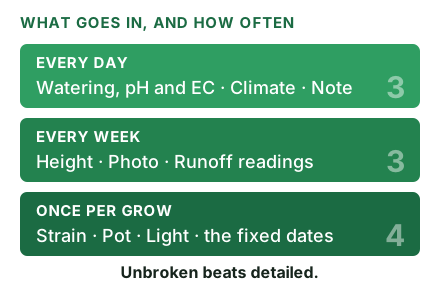
Every watering, in full. Volume, what was in it, pH and EC. Also — especially — when the numbers are the same as last time. This run is the first one you will look at when something is off, and it is the only one you cannot reconstruct afterwards. What actually matters when measuring, and how feed and runoff readings relate, is covered by the pH and EC calculator.
The climate. Temperature and humidity, read once a day. A thermo-hygrometer with a min/max memory turns that into four numbers instead of two at no extra effort: you also see the night, which a single reading at two in the afternoon tells you nothing about.
Whatever caught your eye. One sentence is enough. “Lower leaves going pale”, “noticeably more smell since today”, “left plant droops in the morning”. What matters is the date, not the wording — three weeks later the only thing that counts is when it started.
On a day without watering the first point stays empty. That is not a lapse, it is information: the interval between two feeds is a value you read later as well.
Height. Measured daily, the growth disappears into the margin of error; across a week it is unmistakable. And at the switch to twelve hours, height is the single most valuable number of the whole grow — next time it tells you whether you flipped too early or too late.
One photo, always from the same spot. Same distance, same direction. Two pictures from different angles cannot be compared, two from the same one can be read at a glance. Weekly, that adds up to a picture run across the grow.
The runoff readings. What comes out of the pot tells you whether something is building up in the medium. The same rule applies here: a single value is hard to place, four weeks side by side show immediately whether something is drifting.
These never change and are still the ones most often forgotten — because they feel obvious at the start, and by the next grow nobody remembers what they were.
Strain and breeder. Pot size and medium. The light with its wattage and the distance it hangs at. The day the seed went into water, and the day the seedling broke the surface. Later the day of the switch to twelve hours, and the day the first pistils showed.
The gap between those last two is the number that lets you check almost any breeder claim: flowering times on the packet usually refer to the first pistils, not to the light flip. Write down both and next time you can calculate instead of guessing — the harvest date calculator does that arithmetic for you.
Add every intervention with its date: repotted, trimmed, light raised, dimmed. The PPFD value belongs at exactly these points, because it only changes when you do something — what comes out of that is what the lux to PPFD calculator works out.
Connections almost never show up on the day itself. They show up backwards, when three things line up: the EC has been creeping up over two weeks, the leaf tips have been dark since week six, and the watering interval has stretched from three days to four over the same period.
None of those three stands out on its own. Together they form a picture — but only if all three runs are complete. Take one of them away and you are back to guessing, and next grow you will change something other than the thing that actually caused it.
That is the real work a journal does, and it only starts after the grow is over. Anything not written down while it was running is then gone for good: you can look a number up, but you cannot measure it in hindsight.
At the cut you will want to know how long it took from the flip to here, how much you watered in total, and what was going on in week six. By the grow after next you will want to lay two runs side by side and see what was different — and that only works if both have the same records.
So four numbers belong at the end, summing up the grow: the cut date, the state of the trichomes at that point, the drying time and the yield. What follows from that for the next round is what the yield calculator works out — those are exactly the figures it needs.
After two fully documented grows you stop reading guides and start reading your own numbers. That is the point where a journal is worth more than any manual: it describes your tent, your strain and your water — not an average taken from somebody else’s room.
Every watering in full — volume, nutrients, pH and EC — plus temperature and humidity and one sentence about anything that caught your eye. Including the days when the numbers are identical to yesterday: only an unbroken run makes a later deviation visible at all.
Yes. A single pH reading says almost nothing; it only becomes a statement next to the ones before it, showing either stability or drift. Record only what stands out and you end up with a list of problems and no normal state beside it, which leaves you nothing to compare against.
Once a day is enough if your meter has a min/max memory. Then you write down four numbers instead of two — highest and lowest temperature, highest and lowest humidity — and that covers the night as well. A single reading at two in the afternoon tells you nothing about it.
Weekly, and always photograph from the same spot at the same distance. Daily height growth sits below the margin of error and the daily difference in a photo sits below what the eye picks up — across a week both are unmistakable.
The fixed points that never change: pot size, medium, light wattage and distance, strain and breeder. They feel obvious at the start, and by the next grow nobody remembers them. Along with the two dates the real flowering time comes from — the switch to twelve hours and the first pistils.
Better than nothing, yes, but considerably worse than a continuous one with short entries. Thirty brief days beat ten detailed ones plus twenty missing, because in practice the gap lands exactly where you want to look later. People tend to stop in week three — and what you want to know happens during flowering.
Paper is fine for recording. The difference shows up in two places: in the effort per entry, which decides whether you keep going until harvest, and in the review. Comparing two grows means lining up runs, working out intervals and matching photos — that is the work an app takes off you.
Four numbers: the cut date, the state of the trichomes at that point, the drying time and the yield. The gap between the start of flowering and the cut gives you the real flowering time of your strain under your conditions — the figure on the packet is an average from other people’s rooms.
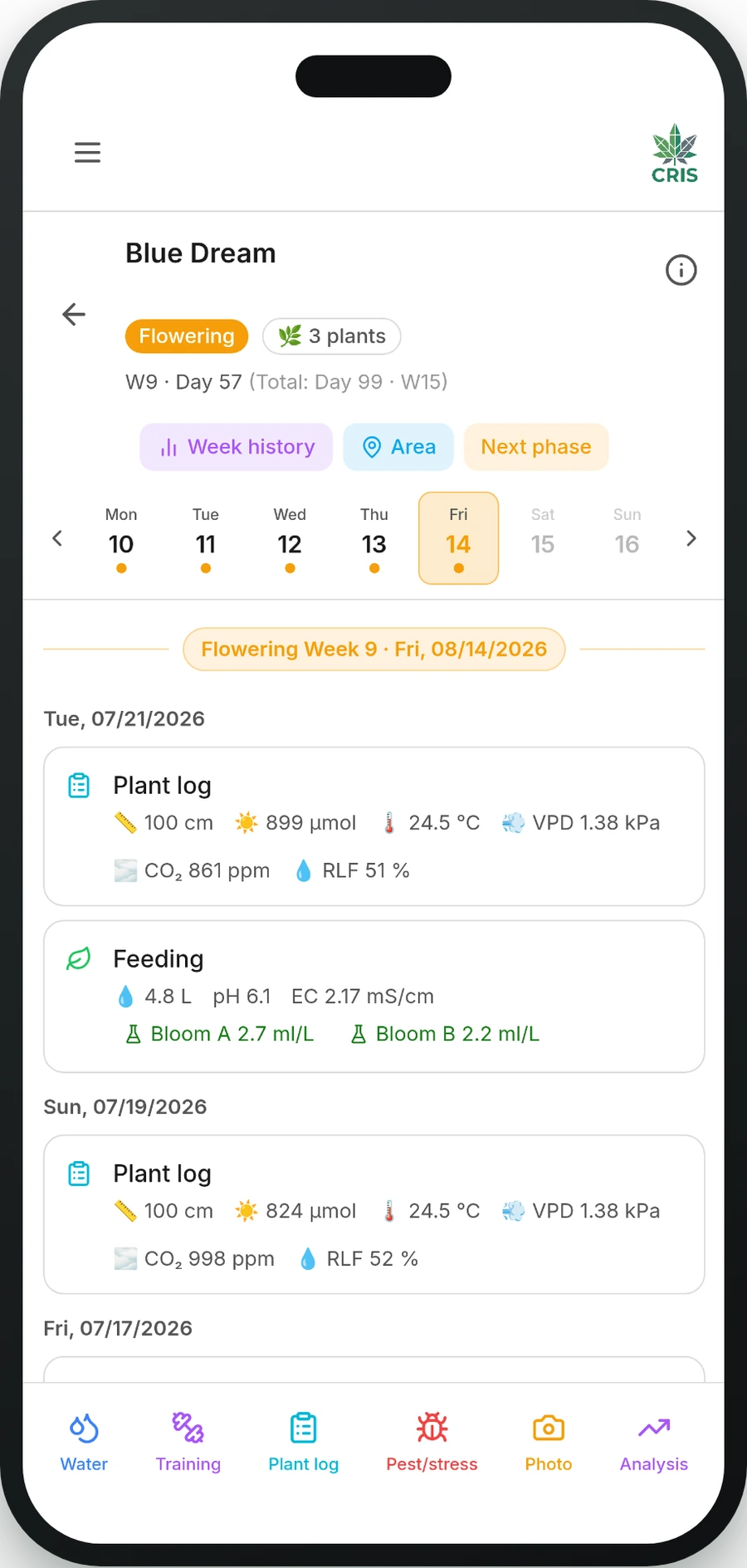
This is exactly what the journal in CRIS is built for: watering with pH and EC, climate, notes and photos in seconds rather than minutes — so the run is still unbroken in week nine. At the end two grows sit side by side, offline and without an account.