

The short answer: with two photoperiod strains, almost always. With a photoperiod and an autoflower together, only as a compromise. What actually decides it is not the flowering time — it is what happens when you harvest inside a tent that is still running.
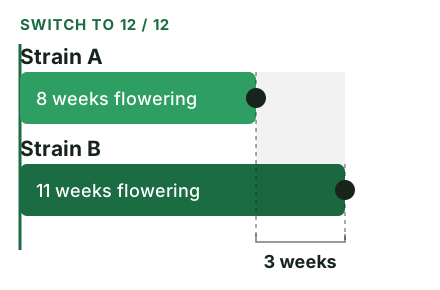
Both sit under the same light cycle, both get the same climate, both are watered from the same can. That one finishes after eight weeks and the other after eleven changes none of that — they simply flower for different lengths of time.
What differs is when you have to get at the plant: once to flush, once to cut. And that is where the three points of this article sit — not in the growing, but in the handover.
Work both timings out before you switch and you know how far apart the harvests fall. That is what the harvest date calculator is for — run it once per strain, from the same 12/12 date.
This is the part the forums keep asking about, and it is the real question behind the whole topic: one plant is ripe, the other needs three more weeks. So you have to cut inside a tent that is still in flower.
It can be done, but it has consequences. The tent stays open longer than usual, you work with light inside it, and you stir up dust and plant matter. For the plant left standing in late flower that is the most delicate moment of the whole run — botrytis needs little more than damp air and movement at the wrong time.
Two things help. Cut the ripe plant completely, in one go, rather than taking branches over several days. And do not dry it in the same space: drying wants a different humidity from flowering, and one tent cannot hold both.
This is not the same thing as a perpetual harvest, which comes up a lot in searches. That means running several tents in rotation so something is always finishing. Here it is one tent and two strains — a different problem with a different answer.
Here two control systems collide. A photoperiod strain flowers because the light drops to twelve hours. An autoflower flowers because it is old enough — it does not take its cue from the timer but from its own calendar.
Autoflowers are therefore happiest on eighteen to twenty hours throughout. Switch to twelve for the photoperiod plant and the autoflower does carry on flowering — but on a third less light per day. It will finish; it will simply give less.
The other way round does not work at all: eighteen hours keeps the photoperiod strain in growth indefinitely. It will not flower, it will keep stretching — and eventually outgrow the tent.
In practice: mixing the two means picking one of the cycles and accepting the penalty on the other plant. A compromise at thirteen or fourteen hours makes it worse for both rather than good for one.
If you flush before harvest, it only applies to one of the plants. The other is mid-flower and still wants its feed. In a shared reservoir that cannot be separated.
In soil it is simple: every pot is watered on its own, so you flush one and keep feeding the other. In DWC or any shared tank it is a real constraint — both plants draw on the same solution, and one of them necessarily gets the wrong thing.
Whether flushing is needed at all is covered in flushing before harvest — the answer there is more reserved than most people expect.
Strains grow to different heights, and the lamp hangs the same distance from both. If one pulls well ahead, it sits too close — and the other gets too little.
The usual fix is blunt: stand the smaller plant higher, on an upturned pot or a crate. That costs nothing and absorbs ten to twenty centimetres without trouble. Raising the lamp instead loses light on both plants.
Better still, prevent it: tie the taller strain down in time and there is no height difference left to correct. The moment for that is the vegetative stage, not flower.
Most of the trouble comes from noticing the gap only once the first plant is ripe. Yet it is fixed in advance: both flowering times are known, and both start on the same day you switch to twelve hours.
Work out both dates before you flip the lights — once per strain. Two weeks apart is nothing. Four or more, and it is worth sending the longer strain into flower later by giving it a shorter vegetative stage.
Whether splitting the space pays at all is a separate question: two strains on one footprint do not yield more together than one well-filled canopy. What to expect is what the yield calculator estimates.
With one strain your memory is enough. With two in the same tent it is not — and that starts on the day you switch, not at harvest.
Three things per plant matter: the day you switched to 12/12 (the same for both, but it is the zero point for both calculations), the flowering time as advertised, and the day you actually cut. The difference between the last two is the figure that counts next time — breeder timings run optimistic almost without exception.
Plus what you did to one plant while the other was still standing: when you flushed, when you trimmed, when the tent was open. If something goes wrong three weeks later, the cause is often in exactly those lines.
With two photoperiod strains, yes, with virtually no caveat: both sit under the same light cycle and get the same climate, they simply finish at different times. What needs thinking through is what happens when you harvest the first plant while the second is still flowering.
Only as a compromise. Autoflowers run on their own clock and want eighteen to twenty hours of light throughout; photoperiod strains only flower at twelve. Switch to 12/12 and the autoflower yields less. Leave the lights at eighteen and the photoperiod plant never flowers at all. A figure in between makes it worse for both.
In one go and completely, rather than taking branches over several days — that keeps the time the tent stands open short. Dry it elsewhere: drying wants a different humidity from flowering, and one tent cannot hold both at once.
No. A perpetual harvest means running several tents or spaces in rotation so that something is always finishing. This is one tent with two strains in it — the plants share a light cycle and a climate, which is exactly what makes the timing awkward.
In soil it is no problem — each pot is watered separately, so you flush one and keep feeding the other. On DWC or a shared reservoir it cannot be separated: both plants draw the same solution, and one of them necessarily gets the wrong thing.
Stand the shorter one higher, on an upturned pot or a crate. That absorbs ten to twenty centimetres and costs nothing. Raising the lamp is the worse answer — both plants lose light that way.
Two weeks is unproblematic. From about four weeks it is worth sending the longer-flowering strain into flower later by shortening its vegetative stage. Both dates are fixed before you switch the lights and can be worked out in advance.
No. Yield follows the footprint and the light, not the number of strains. Two strains on one footprint do not add up to more than a single well-filled canopy — the appeal is the variety, not the volume.
Two strains in one tent means two schedules. In CRIS each plant gets its own entry in the same space — switch date, flowering weeks and day of the cut kept apart, offline and without an account.