


Chapter 3 of 6
The plant now grows faster than it ever will again — and everything you change about its shape in this time decides how many buds it can carry later. Once you switch to flowering, the structure is settled.
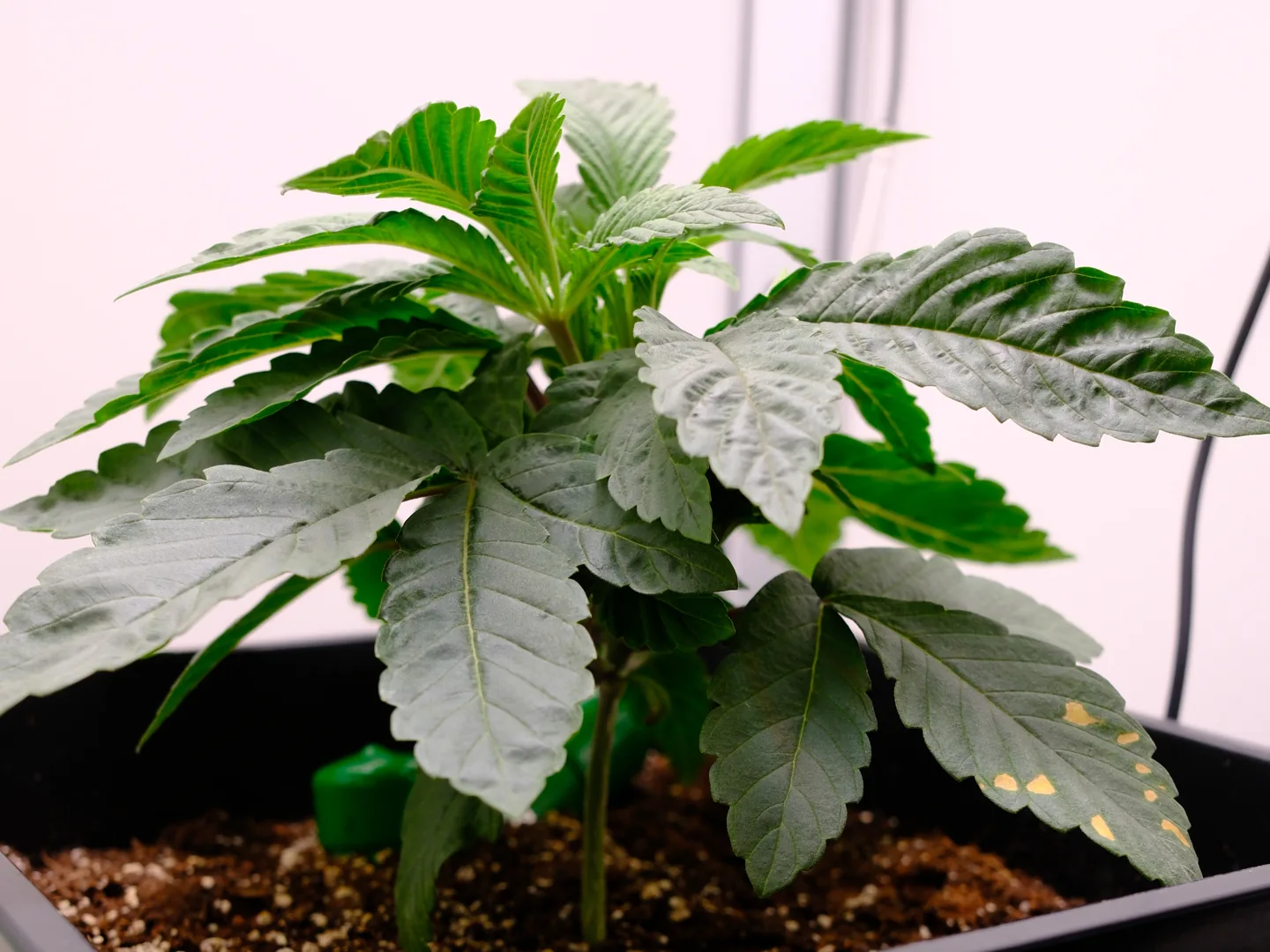
The leaves gain fingers — three first, then five, later seven — and the plant starts a new shoot at every leaf axil. It no longer grows only upwards, it grows outwards.
This is also the point from which it takes considerably more: more light, more water, more nutrients. The restraint that suits a seedling holds a plant back at this stage.
The roots decide how big the plant gets — and a pot that stays too small caps it. A pot that is too big at the outset is no advantage either, because the wet soil no root reaches dries out only slowly.
So you pot on in steps, usually once or twice in this stage. The timing can be read off the plant: when it draws water noticeably faster than it did a week ago, the medium is full of roots.
Change nothing for a day or two after potting on. No feed, no training. The plant usually takes the move without showing anything, but it has enough on its hands as it is.
This is the real decision of the stage, and it has no universal answer — it depends on your headroom. As a rule of thumb a plant doubles to triples its height after the switch to flowering. Flip at a metre (about three feet) and you are planning for two to three.
Count backwards from the height of your tent, less the lamp and the gap beneath it. What is left, divided by three, is roughly the height at which you should be flipping.
The second quantity is time: four weeks of veg give you a different plant from two. If you are planning a harvest date, every extra week of growth moves it by exactly that week.
With autoflowering strains the decision does not arise: they switch by themselves, whatever the light cycle does. Training should be used more sparingly there, because the plant has no time to recover.
Left alone, a plant builds one dominant tip with smaller side shoots below it. Under a lamp that is unhelpful: the tip gets too much light and the rest too little. Training redistributes it.
The plant grows towards the lamp, and the distance that was right last week is not right this week. This is the one adjustment you repeat regularly in this stage.
Too close shows as leaves cupping upwards and bleached tips directly under the lamp; too far shows as stretched gaps between the layers of leaves.
How much light actually arrives at the bottom is something a lux meter will tell you, once converted — the figure falls with the square of the distance, so halving the distance does not mean twice the light, it means four times.
It is triggered through the hours of light: from the long days of veg to twelve hours of light and twelve of darkness. The dark period has to be unbroken — a brief light in the middle of it can disturb the switch.
The change does not show immediately. The plant goes on stretching first, often for a week or two; only after that do the first white hairs appear on the shoots. That stretch is precisely the reason for the rule of thumb above.
The targets change from the flip onwards as well: less humidity, different nutrient ratios. That is the subject of the next chapter.
Four things: every potting on with the pot size, every piece of training, the height at the switch to 12/12 and the day you switched.
The height at the flip is the most valuable note of the whole run. Next time you will know whether you switched too early or too late — and that is the figure most tents come to grief on, not the light and not the feed.
As long as you let it — with photoperiod strains the light cycle decides, not the plant. Three to eight weeks is usual. What that does to your harvest date is shown by the harvest date calculator.
The same as the vegetative stage — the common short form in growing circles. It refers to the time between seedling and flowering, when the plant puts out nothing but leaves and shoots.
When the plant has reached roughly a third to a half of its intended final height — it still doubles to triples after that. The limiting factor is the usable height under the lamp, not the age of the plant.
Tying down is gentler and costs no growth, topping has the stronger effect on structure. Plenty of people combine the two. With autoflowering strains, stick to tying down where you can: they have no time to recover from a cut.
Usually once or twice. The signal is not the calendar but water use: if the plant draws noticeably faster than before, the pot is full of roots.
Considerably more than a seedling, but not yet as much as in flower. The target range per stage — and what your lamp distance actually delivers — is on the PPFD and DLI page.
Usually too little light: the plant is stretching towards the lamp. Less often it is too much warmth. If you reduce the distance, watch afterwards for bleached leaf tips — that would be the other extreme.
In moderation. Large leaves shading a shoot completely can go. Strip a plant wholesale and you take away the surface it runs its growth on — the harm outweighs the light you gain.
No. They start flowering regardless of the light cycle, usually after two to four weeks. The cycle therefore stays the same across the whole run — and anything done to the structure should be done early and sparingly.
By small white hairs in the leaf axils — the first pistils. They show a week or two after the switch. Until then the plant keeps stretching, which is normal and should be planned for.
When did you pot on, when did you top, how tall at the switch to 12/12? CRIS keeps it, offline and without an account. That one figure decides more on the next run than any table.