


Chapter 2 of 6
For two to three weeks a seedling is above all one thing: vulnerable to good intentions. Too much water, too much feed, too much light — most of the losses in this stage come from doing something, not from neglect.
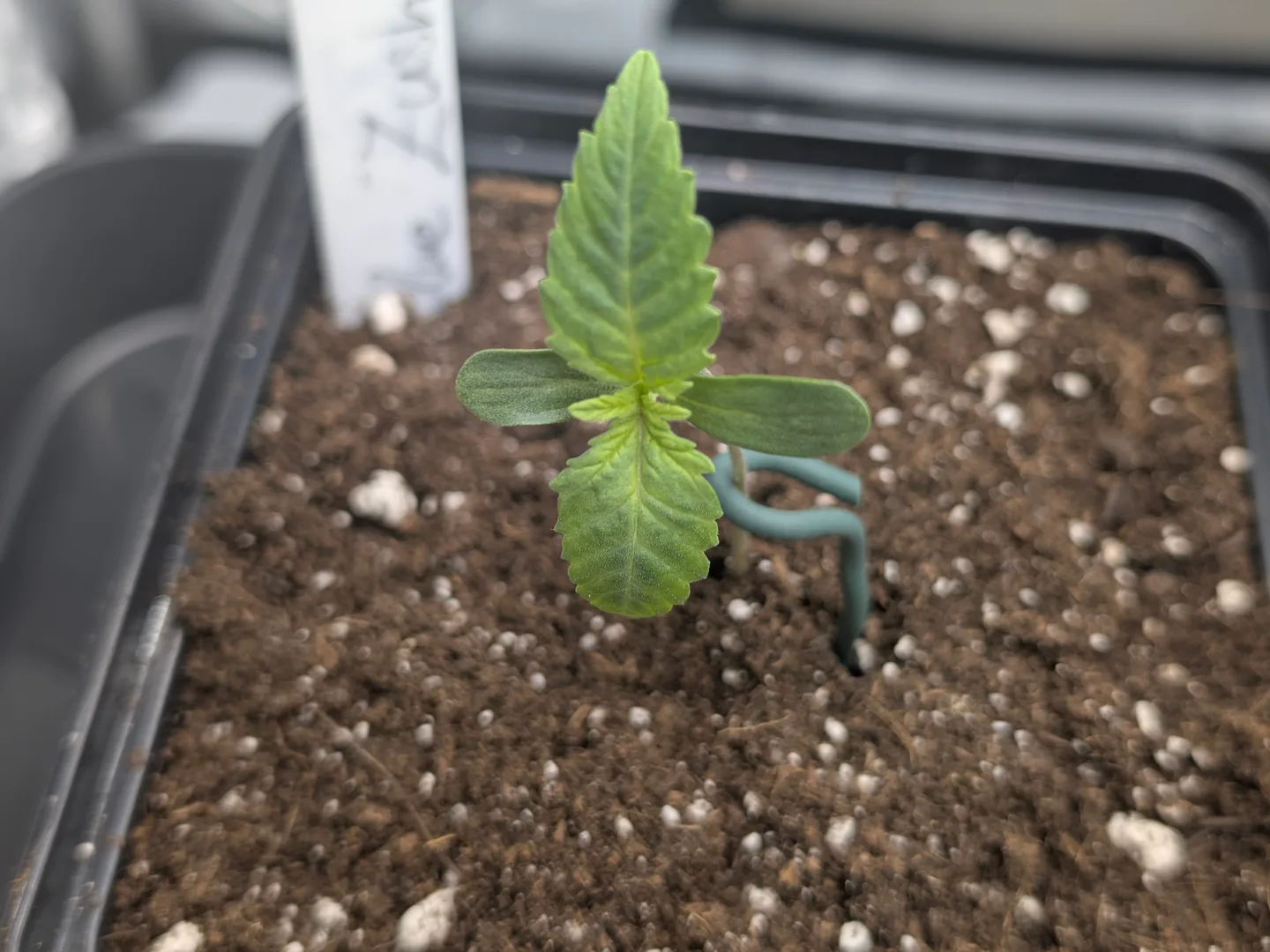
By the first pair of serrated leaves. The two round, smooth ones below them are seed leaves and belong to the seed — they have kept the plant going this far, and later they will yellow and drop. That is not a deficiency, it is the plan.
From the first true pair onwards the plant feeds itself: it photosynthesises and builds roots. The stage runs for roughly two to three weeks and ends when the plant visibly starts going outwards instead of only upwards.
A seedling has a root system the size of a coin and a thirst to match. The pot around it is enormous by comparison, and the wet soil it cannot reach does not dry out. That is exactly what young roots drown in.
So: water in a ring around the stem rather than flooding the whole pot. A small damp area that spreads outwards draws the roots after it. A soaked pot invites them to stay where they are.
When again? When the pot has become noticeably lighter. That is the most reliable test in this stage — the surface can look dry while it is still wet two centimetres down.
Two mistakes are possible here, and they look quite different.
For the first week or two a seedling in pre-fertilised soil needs nothing at all. What came with the seed and what sits in the medium is enough. Feed it anyway and you risk precisely the damage you meant to avoid: burnt leaf tips.
The starting point is considerably weaker than the figure on the bottle, and it is raised over several feeds rather than in one step. How weak depends on the medium: soil brings nutrients of its own, coco and hydro do not.
The targets per stage and medium are on the pH and EC page, along with a mixing calculation for your own tap water.
The right moment is not a date, it is the plant: when the leaves reach out past the rim of the pot and the soil dries noticeably faster than it did at the start, the roots are ready.
Pot on into damp soil, not wet, and keep the root ball intact. A seedling takes the move without trouble as long as the roots are not pulled apart.
If the stem has come out long and thin, this is your opportunity: set it deeper, up to just below the seed leaves. The buried part puts out extra roots, and the plant stands firm afterwards.
Drooping leaves do not automatically mean thirst. They mean the roots are not working — and with seedlings that is more often the result of too much water than of too little.
The difference is in the feel: when it is dry, the leaves are limp and papery and the pot is light. When it is overwatered, they look full and heavy and bend downwards, and the pot is heavy. Watering in the second case makes it worse.
Yellow leaves are usually harmless at this stage as long as they are the lower seed leaves. If the true leaves go yellow or brown from the tips inwards, that was feed.
Three things, and all three pay off on the next run: the day the first true pair of leaves appeared, the day of the first feed along with the dose, and the day you potted on.
The first gives you the length of your seedling stage under your conditions — no guide can tell you that. The second is your reference point when something later goes wrong with the leaves: without a note you are guessing whether it was too early or too much.
Roughly two to three weeks — from the first true pair of leaves to the point where the plant starts growing outwards. Exactly how long depends on light and temperature. For planning a whole run it is part of the starting phase in the harvest date calculator.
Not to a schedule but by weight: when the pot has become noticeably lighter. In a small pot that can be every couple of days, in a large one far less often. A dry surface is not the signal — underneath it can still be wet.
In pre-fertilised soil, usually not at all in the first week or two. In coco or hydro sooner, because there is nothing in the medium to draw on. Start considerably weaker than the bottle says; the targets per medium are on the pH and EC page.
That comes from too little light. It cannot be undone, but it can be softened: when you pot on, set the plant deeper, up to just below the seed leaves. The buried stem grows roots. Raise the light level at the same time, or it will simply happen again.
No. The two round leaves belong to the seed and are shed once the true leaves take over. It only becomes a concern when the serrated leaves go yellow or brown from the tips inwards — that points to too much feed.
Tell them apart by the weight of the pot. A light pot with limp, papery leaves means thirst. A heavy pot with full leaves bending downwards means overwatering — in which case do not water, let it dry out.
When the leaves reach out past the rim and the soil dries noticeably faster than it did at first. Both are signs of a medium full of roots. There is no fixed date for it.
Considerably less than a grown plant — full output from day one will scorch it. How much actually arrives is something a lux meter will tell you, and the lux to PPFD calculator converts it; the target range per stage is on that page too.
It is not necessary, but it does help: it keeps the air evenly moist without any watering. The important part is opening it in good time — left closed too long, the plant never gets used to the drier air of the room.
The plant stops growing only upwards and starts putting out side shoots and broader leaves with more fingers. From there the vegetative stage begins — and the demand for light and nutrients rises sharply.
When was the first feed, when did you pot on? CRIS keeps it — offline on your phone, no account. On the next grow it is an answer instead of a gap in your memory.